Thought Machine’s Gender Pay Gap: A snapshot of April 2025

What is the gender pay gap?

At Thought Machine, we calculate our gender pay gap based on UK Government guidance:

The gender pay gap is the difference between the average (mean or median) earnings of men and women across a workforce.

Companies that employ more than 250 people (like Thought Machine) are legally required to publish a snapshot of their gender pay gap each year, using data from the year prior. The following data is a snapshot of our gender pay gap position as of April 2024.

The methodology

The data is not a measure of pay equality (it is a legal requirement for men and women performing equal work to receive equal pay). By looking at the data in aggregate, we see a picture of the overall differences in pay between men and women in the business. This data also reveals the kinds of roles held by men and women – and which gender is more or less represented in different salary bands.

It is an opportunity for us at Thought Machine to observe the disparity in pay between men and women across the business and ask ourselves the question as to why those differences exist.

We have collected and analysed data with regard to:

  • Average hourly pay for men and women
  • Bonus pay for men and women
  • The proportion of men and women in different pay quartiles
Diversity and Inclusion

Since 2020, we have been actively working to improve our gender representation, leveraging our Employee Resource Groups (ERGs) and implementing strategies to recruit and retain more women across the organisation. After losing some women in key senior leadership roles during redundancies in 2023, we have continued to hire at a steady rate and have focused on hiring women to close the gap. 

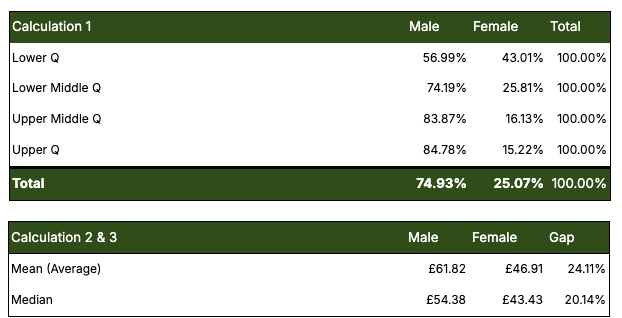
Despite this, our median pay gap has increased slightly from 19.25% in 2024 to 20.14% in 2025. This continues to be driven by having more men in the senior leadership team.

Understanding the gap

As above, we have increased the percentage of women in the upper quartile, and significantly improved the percentage of women in the lower middle quartile, but we have also seen a reduction of women in the upper middle quartile.

Comments on calculation methods

The Gender Pay Gap highlights broader labour market inequalities, such as more senior roles being held by men. It is not a measure of equal pay. The legislation provides a valuable framework for transparency, though the specific calculation requirements can occasionally result in data anomalies.  The calculation looks at a certain snapshot in time (April 5th 2025) rather than a full-year average. This aims to reduce gender bias as more women may work part time, but this method comes with its own problems.

Firstly, for employees on maternity leave who have moved past the six-month full-pay threshold by the April 5th snapshot, the data captures their reduced pay. This creates a figure significantly lower than their contracted annual salary, which can disproportionately affect the overall average for that period.

Additionally, our compensation structure includes commission, which is captured in the Bonus Gap results; this year, a higher proportion of women received bonuses, and the median for women exceeded that of men. However, the snapshot rules require any commission paid in April 2025 to be treated as “regular pay”.  One significant commission payment during this specific window impacted our figures, contributing to a 5% increase in the mean Gender Pay Gap––moving it from 19.45%* to 24.11%. This highlight illustrates how isolated, high-performance milestones can skew the data in a single reporting month.

Bonus pay gap

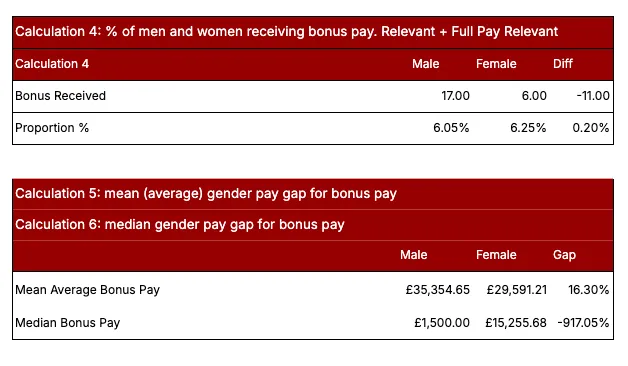
  • We’ve seen a year-on-year reduction in our bonus pay gap from 89% in 2022, to just 16% in 2025. This is a result of us increasing the percentage of women hired in sales and sales engineering teams, therefore increasing the population of women able to receive commission. 
  • We have calculated that 17 men and six women received a bonus. Although we do not pay bonuses, we offer sales and recruitment referral commissions, which are classified as bonuses for this report.
  • The difference in mean and median bonus pay again highlights the issues in the calculation and the impact of outliers in regards to commission. The mean bonus pay gap is 16% but the median pay gap is -917% (meaning the median bonus for women was 917% more than the median bonus for men).
*our 2025 Gender Pay Gap calculation without this commission figure paid in the month of April

What have we done to close the gap?

In 2025, we increased the percentage of female hires to 36%, which in turn grew the total representation of women in the organisation from 23.7% to 25.2%. We are continuing to recruit throughout 2026 and we aim to continue to have at least 35% of all new hires as women.

Our 2025 internship programme was another year where we had a 50:50 split between males and females. Although this doesn’t impact our Gender Pay Gap (the interns are employed between July and August), a significant percentage of these individuals return as permanent employees upon graduation. It’s important to recognise that there is a limited number of potential female hires in the industry, which is driven by many socio-cultural factors. We hope that an increasing number of women studying Computer Science at an undergraduate level will shift this needle in time. Although this results in a greater percentage of women in the lower pay quartile, we are dedicated to supporting this trend as it increases Thought Machine’s likelihood to attract female talent in the long term. It also positively influences the technology ecosystem by providing more women with valuable experience in the tech industry and software engineering roles.

Each year, we monitor promotions and level changes by gender across the company. We are pleased to share that once again, in 2025, women were promoted at a similar rate to men relative to their representation in the organisation. This has contributed to more women moving into the lower middle, and upper quartiles of pay. 

We have had continued success with our “return to work” coaching programme designed for people taking maternity leave. Women participating in the programme have reported increased confidence in both leaving and returning to their roles. They also feel more supported by their managers during this transition. We are realising the positive impact of this initiative and will continue to improve the retention of women and further close the gender gap by encouraging more women to re-enter the workforce after an extended break.

Signed – Matt Wilkins, Chief People Officer, Thought Machine

Matt Wilkins signature
Sign up to our newsletter
Thank you! You will now receive some incredible content in your inbox!
Oops! Something went wrong while submitting the form.
For information about how we use your data please read our privacy policy.