Part 2: How native ISO 20022 orchestration prepares you for Swift Case Management
In part 1, we looked at why the structured address extension is a head start rather than a pause. The next milestone is already set: by November 2027, all cross-border payment cancellations and Exceptions & Investigations (E&I) messages must use dedicated ISO 20022 formats and be routed through Swift Case Management.¹ ²
Investigations are one of the slowest, most manual parts of cross-border payments. According to Swift, resolving a single case takes 5–10 days on average, driven by manual workflows, free-format messages and the need for every intermediary bank in the chain to review and forward each request.² For a customer chasing a delayed payment, confirming beneficiary details or requesting a return, that wait is frustrating. For the banks involved, it's expensive.
Institutions that prepare now can turn a compliance deadline into faster resolution times, lower operating costs and better client experience. Those that bolt new messages onto legacy systems will repeat the same mistakes as the ISO shim.
What's actually changing?
Two things change at once: how investigations are routed, and the messages used to send them.
From chain routing to central case management. Today, a query travels hop by hop through every bank in the payment chain. Swift Case Management replaces this with a central service, so institutions communicate directly and messages only go to the parties that need them.³ Built on the real-time tracking capabilities of Swift GPI, it has two main components:
- Case Orchestrator: handles and manages exceptions and investigations from start to finish.
- Stop and Recall: improves speed and transparency when stopping payments and processing refunds.
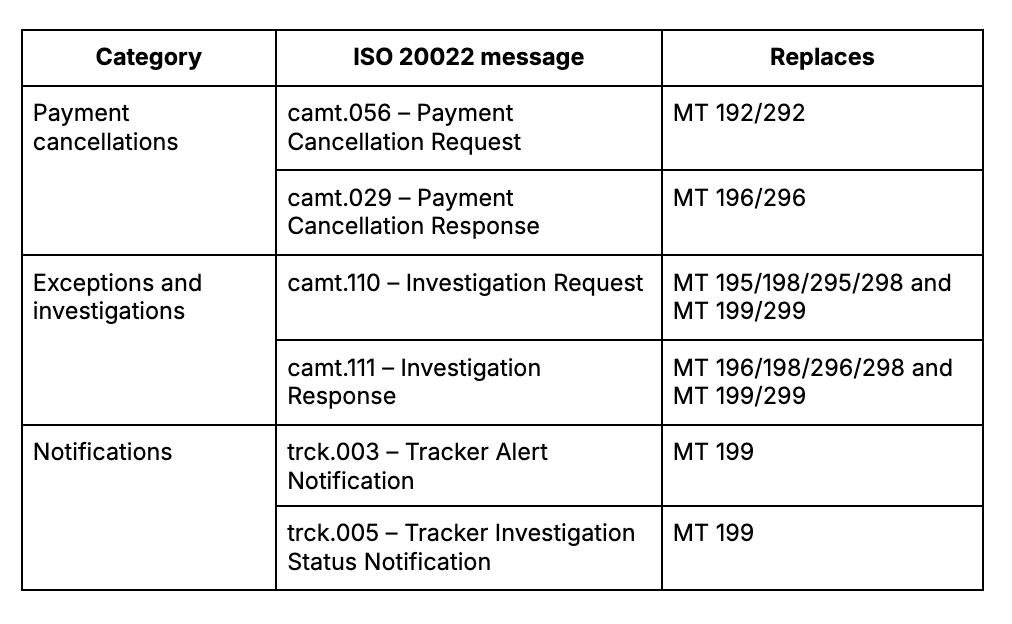
From free text to structured messages. New ISO 20022 messages replace free-format MT queries with a strict request-and-response pattern, mandatory replies and predefined codes. Each case carries an End-to-End Investigation Reference (EIR), similar to the Unique End-to-End Transaction Reference (UETR) that identifies the payment itself.⁴
You don't have to wait until 2027
The mandate lands in November 2027, but the new messages are available much sooner:
- From November 2026: institutions can receive camt.110 investigation requests, even without onboarding to Case Management. Swift also runs an early adopter programme for Case Management, so banks can start testing the new message set now.
- During the transition: if the next agent in the chain isn't yet participating, you can still reply to an incoming camt.110 with an MT 199. In this scenario, the camt.110 may carry an embedded, translated version of the MT 199.
- From November 2027: all payment cancellation and E&I messages must use the specified ISO 20022 formats and be routed via Case Management.
Why bolt-on modules create the same technical debt
For institutions running payment systems that aren't built on ISO 20022, adopting the new E&I messages and making use of their additional data will be challenging. The instinct is to plug in another module or customise the legacy platform. But that recreates the problem we described in Part 1:
- Rigid, vendor-dependent updates: every new message type and interface needs code changes, tying your timeline to someone else's release cycle.
- Lost data: if the core can't store or process the richer data in E&I messages, it gets truncated or ignored, and investigations lose the context that should speed them up.
- Extra orchestration layers: interfacing with Swift without native ISO 20022 support forces institutions to build and maintain complex external orchestration layers to handle message validation and enrichment.
The solution: ISO 20022-native orchestration
Swift provides the network infrastructure. Vault Payments handles everything on your side of it, natively supporting all the required ISO 20022 messages so you don't need to build a separate orchestration layer to connect to Swift:
- Validation and enrichment before sending: run pre-checks, data enrichment and business rule validation within Vault Payments, catching issues early and avoiding unnecessary rejections, fees and back-and-forth across the network.
- Centralised case workflows: manage case handling, smart routing and tracking in a single interface within Vault Payments, giving operations teams full control.
- Automated processing and tracking: ISO 20022-compliant RESTful APIs retrieve Swift tracker updates in real time and trigger the next action automatically, with end-to-end transparency and automated reminders to help teams resolve cases faster and more accurately.
- Native ISO 20022 support: an embedded ISO 20022 e-repository and a unified data model standardise every payment message into a single Instruction resource.
- Configuration, not code: New message types such as camt.110 and camt.111, and the data elements they carry, can be supported through configuration rather than custom development, giving your bank full control over how these messages are handled
Build the foundation once
Structured addresses and E&I teach the same lesson: each new ISO 20022 mandate tests whether your platform can adapt, or whether you'll pay for another workaround. Together, Swift Case Management and the new message set will make a significant contribution to the G20's goals of reducing friction and processing times in cross-border payments. The institutions that benefit most will be those whose platforms can use the data, not just pass it along.
The decisions you make now will shape your payment platform for years to come. Choosing an ISO 20022-native foundation means meeting each new mandate through configuration, resolving investigations faster and giving clients the speed and transparency they expect.
Ready to get ahead of the E&I migration?
[Book a meeting with our Payments team]
References
- https://flow.db.com/publications/flow-white-papers-and-guides/guide-to-iso-20022-exceptions-and-investigations-e-i-migration-and-case-orchestration
- https://www.Swift.com/sites/default/files/files/its-time-to-transform-exceptions-and-investigations-april2025.pdf
- https://www.Swift.com/products/case-management
- https://www.Swift.com/standards/iso-20022/iso-20022-faqs/iso-20022-exceptions-and-investigations